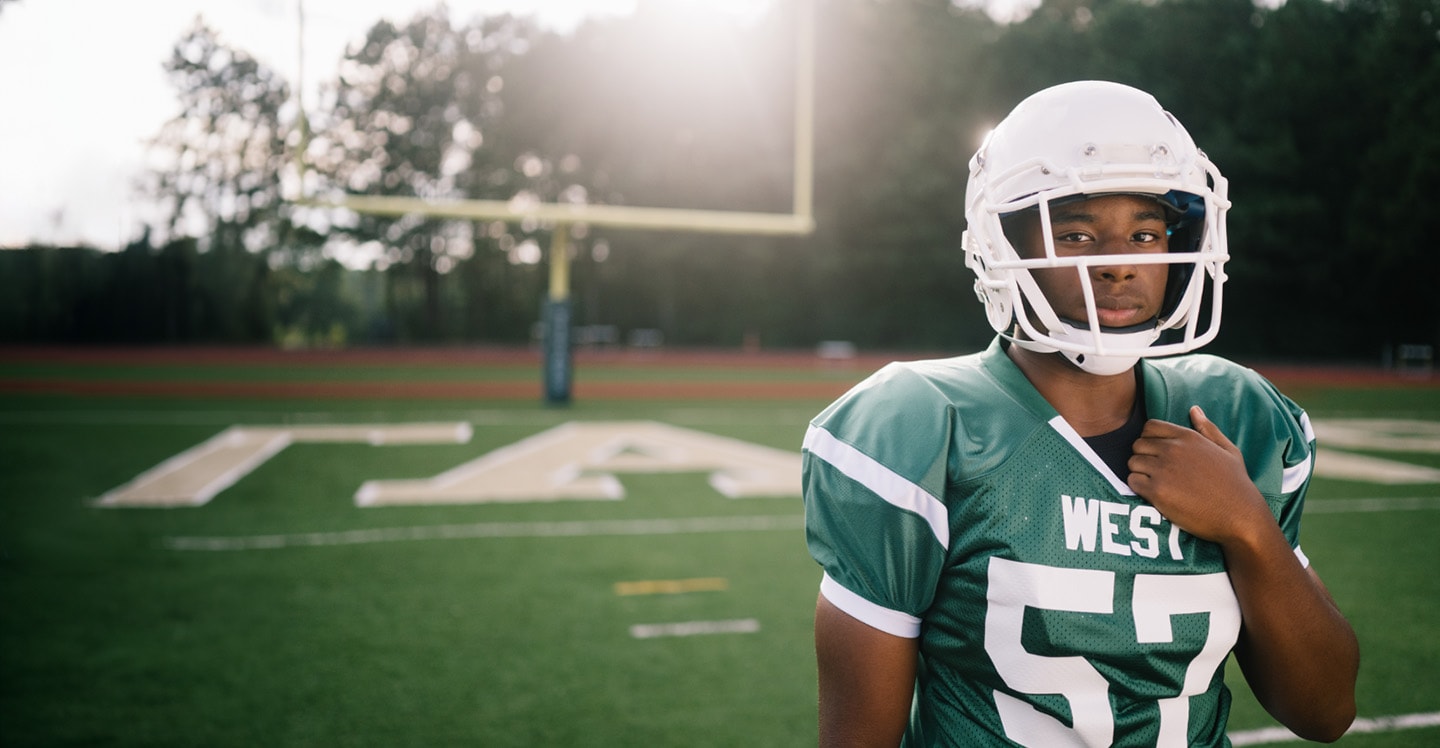
A concussion is an injury to the brain. It can be caused by a blow or bump to or around the head. This causes the brain to move inside the skull, which can change how the brain works or processes information.
- It’s estimated that 1.6 to 3.8 million concussions occur every year—many of those go unreported or unnoticed.
- Boys and girls respond differently to concussions. On average, girls take a few days longer to recover than boys. Younger athletes typically take longer to recover from concussions than older athletes.
- Of any sport, football carries the highest risk of concussion. Next is soccer and basketball. As lacrosse grows in popularity, it may account for a significant number of concussions as well.
If you suspect your child has a concussion, talk to your child’s doctor. All head injuries should be taken seriously. In case of an urgent concern or emergency, call 911 or go to the nearest emergency department right away.
If your child is participating in a sport at the time of injury, take him out of the game or practice. Your child should avoid activities that put him at risk for another head injury soon after the first one. A child should recover and be completely symptom-free at rest and with physical exertion before returning to sports or other activities. Before a youth athlete can return to play, he must be cleared by a healthcare provider trained in the management of concussions.
Steps to get help when your child has a concussion:
1. Contact your pediatrician, or visit a Children’s Urgent Care Center or Emergency Department.
- Find a pediatrician.
- Locate your closest Children’s Urgent Care Center.
- Locate your closest Children’s Emergency Department.
2. Get your non-urgent questions answered.
- If a doctor has diagnosed your child with a concussion and you still have questions about his treatment, contact our concussion nurse. Call 404-785-KIDS (5437) and ask for the concussion nurse.
- The concussion nurse is available 8 a.m. to 3 p.m., Monday through Friday. If you call after 3 p.m. or on weekends or holidays, leave a message, and the nurse will return your call the next business day.
Minor Bump or Serious Head Injury? Learn Concussion Awareness, Prevention Tips and Guidance.


Any head injury your child receives should be taken seriously regardless of the activity or age of the child. It’s important to be observant, understand the signs and symptoms of a concussion, err on the side of safety and trust your gut. When in doubt, call your child’s doctor.
There are many different ways a concussion can show itself. Your child may exhibit just one or two symptoms, or quite a few. You might not even see any symptoms until a few days after the injury.
Common signs of a concussion may include:
- Confusion
- Headache
- Clumsy movement or dizziness
- Nausea or vomiting
- Memory loss
- Tiredness
- Upset stomach
- Vision problems
- Sensitivity to noise and light
- Numbness or tingling anywhere on the body
- Loss of balance or trouble walking
- Mental fogginess (cannot think clearly or remember things)
- Slurred speech or other changes in speech
- Irritability or more fussiness than usual
- Different behavior than usual—does not play, acts fussy or seems confused
- More emotional, perhaps very sad or nervous
- Different sleeping patterns
What’s the number one symptom? A headache is the most common symptom. However, you can still have a concussion without a headache. Keep in mind, since a concussion does not involve a structural injury to the brain, imaging such as a CT scan or MRI will look normal. Most importantly, healing occurs over time and not right away.
One common misconception is that a concussion results in the loss of consciousness. This can be a dangerous assumption because this is only true about 10 percent of the time.
Why you should test your child BEFORE an injury happens
Your child’s doctor may recommend an ImPACT evaluation as a means of monitoring your child’s brain health and safety. Since symptoms, responses and recovery patterns vary by child, it’s helpful to know what “normal” cognitive function is for each athlete. Baseline testing is recommended for athletes who participate in contact or high-impact sports. This baseline information will help more accurately determine when your child’s cognitive function has returned to “normal” if/when your child does get a concussion.
You should watch your child very carefully in the first one to two days after a concussion. Call your child’s doctor immediately, go to the emergency room or call 911 if your child has any new symptoms or if symptoms get worse, such as:
- Worsening headaches
- Clear drainage from the nose or ear
- Scalp swelling that gets bigger
- A seizure
- Neck pain
- Is hard to wake up
- Vomits more than once
- Acts differently than usual, such as if he does not play, acts fussy or seems confused
- Cannot think clearly or remember things
- Has weakness in the arms or legs or does not move them as usual
- Cannot recognize people or places
- Slurred speech
- Passes out
Athletes who suffer a concussion have a three to four times higher risk of suffering a second concussion. The second concussion may be caused by a milder impact, and the symptoms typically last longer than with the first one.
Second impact syndrome
We cannot stress enough how important it is that your child wait for full recovery before getting back in the game. If an athlete suffers a second blow to the head before fully recovering from a concussion, the consequence can be catastrophic. Second impact syndrome (SIS) results in a massive rush of blood into the brain causing irreversible brain swelling, seizures, coma or death in one-half of all cases. Over 90 percent of survivors of SIS have permanent brain damage.
Post-concussive syndrome
When an athlete suffers from concussion symptoms for over six weeks, it’s called post-concussive syndrome. It’s difficult to predict who will get post-concussive syndrome, but kids with a previous concussion, ADHD, migraines or any other neurological condition may be at higher risk.
When it comes to caring for concussions, there are specific national guidelines and best practices from a number of organizations.
Each concussion is unique. Symptoms and recovery time are different for each child or teen. It’s important to remember that rest for the brain and body is critical when you are recovering from a concussion. Rest, both cognitive (for the brain) and physical (for the body), is the best treatment.
Your child’s doctor may keep your child out of sports, school or other activities. Depending on how severe the concussion is, it can take days, weeks or months for your child’s brain to totally heal.
Here are some guidelines for helping your child recover from a concussion:
- Limit physical activities like play. Don’t allow your child to return to gym class or sports until your doctor says it’s OK.
- Don’t allow too many visitors. Keep visits short.
- Keep surroundings calm and quiet.
- Be sure to keep your child’s doctor appointments, even if he is feeling better.
- Be patient. A concussion may temporarily make it hard for your child to focus, remember things or complete tasks.
- Limit thinking activities to easy books and simple arts and crafts projects. Limit screen activities (TV, video games, computers and cellphones) to no more than two hours a day for no longer than 30 minutes at a time.
- Have your child stop and rest any time symptoms get worse.
- Serious problems after a concussion are rare but can occur. That’s why a medical doctor should always be involved in a child’s care after a concussion.
Located at the Center for Advanced Pediatrics, our Multidisciplinary Complex Concussion Clinic offers coordinated care (by internal referral and appointment only) for patients who sustained a concussion and have prolonged symptoms that require the expertise of two or more specialists.
Our unique approach to multidisciplinary care will provide a one-stop-shop approach for complex concussion patients and their families. Our team combines the expertise of a range of specialists to help coordinate patient care. Our specialists will collaborate to customize the care path and treatment strategy for the symptoms and goals of each patient, with the ultimate goal of returning each patient to his or her sport, performance, activities and day-to-day life.
- Ask your doctor before giving your child any pain medicines.
- Don’t give your child any medicines that can cause sleepiness—like cold medicines or medicines for itching—until you check with your doctor.
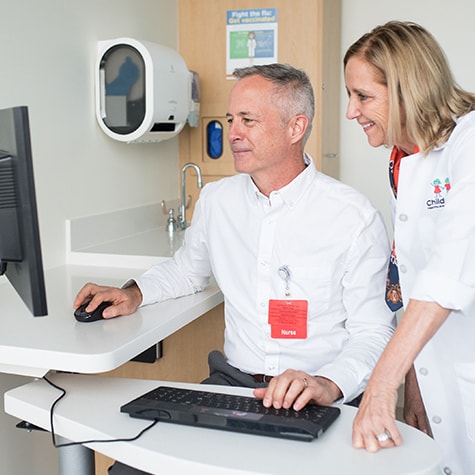
If you’re a medical professional, we have special resources for concussion education.
Please visit our physician resources for concussion section, which includes our concussion video series, concussion referral form and concussion toolkit.
CONNECT HERE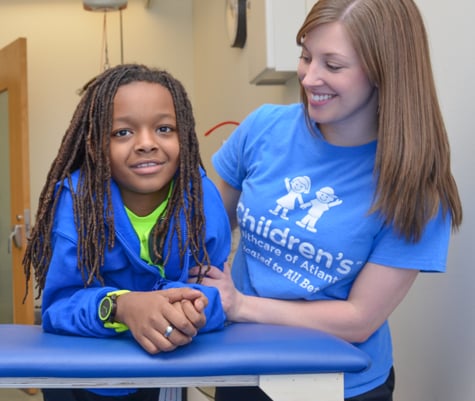
Our team of pediatric specialists knows how to care for concussions and can work with your child’s doctor for special care.

The Return to Play Act of 2013 aims to protect young athletes from concussion injuries.
Your child’s school must have a concussion policy for sports. It must include informing parents about the concussion risks, removing any player showing concussion symptoms, and clearing an athlete to return to play only through a specially trained healthcare provider.
SEE MORE SCHOOL RESOURCESOur Concussion Program combines the expertise of specialists from Children’s Physician Group as well as community physicians to help coordinate patient care. Our doctors and surgeons work closely with community providers to help ensure complete, coordinated care is delivered seamlessly. Our program is led by Medical Director Andrew Reisner, MD, and Medical Director of Concussion Research, Thomas G. Burns, PsyD, ABPP, CN.
Children's Physician Group
Hospitalist
Neurology
Neuropsychology
- Laura Blackwell, PhD, ABPP
- Thomas G. Burns, PsyD, ABPP, CN
- Elyssa Gerst, PhD
- Jacqueline Kiefel, PhD
- David J. Marcus, PhD
Neurosurgery
Physiatry
Psychologist
Sports Medicine Primary Care
Contact Us 404-785-KIDS (5437)